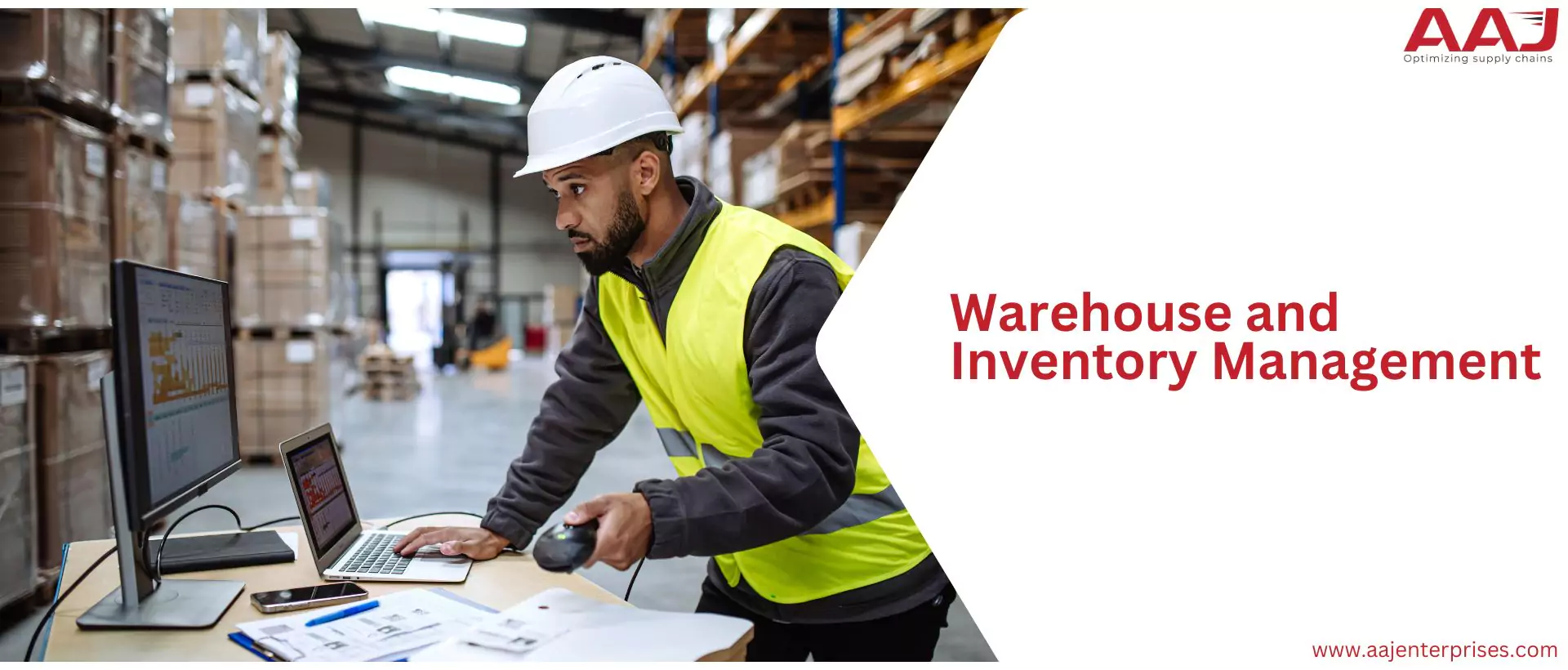

Warehouse management and inventory management are intertwined yet they are not synonymous. Both are key to building an efficient supply chain, having products available when and where they are required, managing costs and delivering accurate customer orders.
Warehouse management relates to the movement of goods in the warehouse and its management, while inventory management relates to the right quantity of stock at the right time.
By harmonizing these two features, companies can achieve a more streamlined inventory management process, optimize storage space, cut down on overheads and ensure faster and more accurate order fulfillment.
What is Warehouse Management?
Warehouse management is the process of controlling and optimizing activities that take place inside a warehouse.
It includes the physical movement of goods as they move through the organisation until they are sent out. This encompasses: Receiving, putaway, storage, picking, packing and shipping.
The goal of the warehouse management process is to ensure that products are stored appropriately, readily available and moved efficiently throughout the warehouse.
Other important aspects of warehouse management include warehouse location organization, warehouse resource management, records and workflow optimization.
What Is Inventory Management?
Inventory management is the process of planning, tracking and controlling the inventory stock that a business has.
It emphasizes keeping the proper level of stock in order to satisfy demand without overstocking or incurring unnecessary storage costs.
Inventory Management includes activities like forecasting, ordering, inventory control, inventory counting and reordering.
Warehouse management is primarily on how inventory should flow through the warehouse, while inventory management is about how much inventory should be available and when it should be replenished.
Key Differences Between Warehouse and Inventory Management
The two functions overlap, but their primary responsibilities are different.
| Factor | Warehouse Management | Inventory Management |
|---|---|---|
Primary focus | Movement and handling of goods | Quantity and availability of stock |
Main objective | Efficient warehouse operations | Maintain optimal inventory levels |
Scope | Receiving, storage, picking, packing and shipping | Forecasting, purchasing, replenishment and stock control |
Key concern | Where and how goods are handled | What quantity should be available |
Typical technology | WMS, barcode, RFID | IMS, ERP, forecasting and inventory tools |
Key outcomes | Faster workflows and better space utilization | Better stock availability and inventory accuracy |
In practice, a business needs both. Accurate inventory information is difficult to maintain without disciplined warehouse processes, while an efficient warehouse cannot perform well if inventory planning is inaccurate.
How Warehouse and Inventory Management Work Together
Warehouse operation and inventory management shouldn't be two distinct chores.
Inventory planning will establish the proper product availability, quantity to order and when to replenish. Then it is the responsibility of warehouse management to receive, store, locate and dispatch those products efficiently.
For instance, when a specific SKU is getting close to the reorder level, the buyers can order the item. On receipt of the shipment, the products are put away in the warehouse. The warehouse picks the product and packs it for the customer when it is ordered.
This forms a cycle, one that repeats itself:
Forecast → Purchase → Receive → Store → Track → Replenish → Pick → Pack → Ship → Reconcile
An accurate information movement through this cycle provides better control of warehouse operations and inventory levels for businesses.
Warehouse Management Workflow
There are a number of sequential stages in a typical warehouse procedure:
1. Receiving
Receiving starts at the time of goods arrival at the warehouse.
The Warehouse team checks the shipment with the applicable Purchase Order, Transfer or Inbound. Any quantity and product identification and condition may be verified prior to the acceptance of inventory.
The accuracy of the receive is essential as any errors made in the receive process can impact any process or inventory downstream.
2. Putaway
Products are transferred to their storage places once received.
The purpose of putaway is to determine the location for the goods based on product type, size, demand, storage needs and available space.
Effective putaway minimises unnecessary movements and helps to locate products during picking.
3. Storage
Storage is a continuous process of handling goods in the warehouse.
Products should be stored in an orderly manner with the proper location, labelling and handling procedures. Proper storage not only helps to make better use of space, but also makes it easier to use inventory.
If a product has a shelf-life consideration, some methods can be used to ensure that the older stock is sent out before newer stock if necessary, e.g. FIFO (First In, First Out).
4. Picking
Picking is the process of retrieving products from storage after an order is received.
It is imperative to get it right as it can result in fulfilment errors, returns and customer unhappiness if the right SKU or quantity is not ordered.
Warehouse teams can utilise technology such as barcode scanning, optimised picking routes and more to enhance picking speed and accuracy.
5. Packing
Picked products are inspected and packaged based on shipments and product specifications. Packing helps to protect the goods in transit and to ensure that the right items are ready for shipment. Certain warehouses also do value-add tasks like labelling, kitting and custom packaging at this time.
6. Shipping
The delivery is the last stage of the warehouse.
Packed orders are passed on to suitable transportation network and shipping information recorded for tracking and delivery management.
The key to shipping efficiently is in having accurate inventory, order information, packing and documentation practices.
Inventory Management Workflow
The level of planning and control for inventory management is higher.
1. Forecasting
Inventory forecasting is the process of estimating the quantity of products and/or services needed in the future, based on information that is available to the business, including historical demand, seasonality and expected changes in demand.
Forecasting accuracy allows businesses to figure out the amount of stock they might require and minimise the risk of overstocking or stockouts.
2. Purchasing
Purchasing involves ordering products or materials required to maintain inventory levels.
When making purchases, it is important to take into account expected demand, supplier lead times, stock levels and consumption.
3. Stock Control
Stock control is a process of keeping track of the amount and condition of stock in the enterprise.
It assists in answering key questions like:
- What inventory is available?
- Where is it located?
- How much has been committed to orders?
- Which products are running low?
- Which products are moving slowly?
4. Replenishment
Replenishment is the process of restoring inventory, when stock reaches a specified level, or when future demand calls for more inventory.
Effective replenishment can help to balance inventory carrying costs and product availability.
5. Cycle Counting
A technique of periodically checking a selected group of inventory rather than counting it all at once.
A count can be made of different products or locations based on various factors including value, movement or business importance. Regular cycle counts can detect discrepancies and ensure more accurate inventory records.
Technology for Warehouse and Inventory Management
The technology involves linking physical activities in the warehouse with inventory information and business planning.
Warehouse Management System (WMS)
Warehouse Management System (WMS) is an information system that controls the activities of a warehouse that includes receiving, putaway, storage, picking, packing and shipping.
It can also be used to locate inventory within the warehouse, streamline processes and provide more visibility of warehouse operations.
Inventory Management System (IMS)
An Inventory Management System (IMS) mainly deals with the stock levels, the flow of stock, availability and replenishment. It enables businesses to keep their stock levels under control in various branches and channels.
Enterprise Resource Planning (ERP)
An ERP system also integrates the information of the inventory and warehouse with other business processes, like purchasing, finance, sales and operations.
The integration of ERP and WMS systems and inventory systems decrease the information gaps between departments.
Barcode Technology
Barcodes can be used to identify and track products, cartons or storage area.
Using Barcode during Receiving, Putaway, Picking, Packing, Shipping and Returns and Stock Counting helps to minimize manual data entry.
RFID
Radio Frequency Identification (RFID) tags and readers are used to identify and track objects without being required to read the tags directly as a traditional barcode does.
RFID can enhance visibility and automate aspects of inventory management and warehouse operations, depending on the operation.
Key Warehouse and Inventory KPIs
Businesses should track measurable performance indicators rather than relying only on operational observations.
Inventory Accuracy
Inventory accuracy is the degree to which the inventory records are in sync with the actual stock on hand. Reliable inventory planning and order fulfilment depends on high accuracy.
Space Utilization
Space utilization assesses the efficiency of the use of the space available in a warehouse. Gaining additional capacity need not be a building operation, but can be achieved through better slotting, organized storage and efficient putaway.
Fill Rate
Fill rate is a percentage of the amount of product available to meet customer demand. Fill rate is typically a good indicator of products being available when required.
Inventory Turnover
The inventory turnover is the number of times the stock is replaced in one year. If the turnover is very low, it can signal excess or slow-moving inventory and if turnover is very high, the planning of inventory replenishment needs to be carefully managed.
Order Accuracy
Order accuracy is a measure of the warehouse's consistency to send the right products, right quantity. It is an important indicator of picking and fulfilment performance.
Best Practices for Warehouse and Inventory Management
The cornerstones of a good operation are good processes, good information and continuous improvement.
1. Maintain accurate master data.
Product size, SKU, location and inventory data must be up to date as it can impact the execution of warehouse orders and inventory planning.
2. Reduce unnecessary manual entry.
Apply barcode scanning, RFID and integrated systems as needed to minimise error and quicken the transactions.
3. Use demand forecasting.
Requirements can be forecasted and the risks of excess stock and stockouts can be lowered with the use of historical data and business trends.
4. Establish clear warehouse processes.
Standard procedures for receiving, putaway, picking, packing and shipping, ensure consistency and efficiency.
5. Perform regular cycle counts.
Regular stock-takes will help to detect stock discrepancies early and avoid mistakes building up.
6. Optimize storage locations.
Products likely to be picked can be placed in convenient locations, whereas storage spaces should be planned to take into account product characteristics, movement and space needs.
7. Train warehouse teams.
The employees should be aware of the process of the warehouse, inventory and the technology they use on a daily basis.
8. Monitor KPIs continuously.
Monitoring inventory accuracy, utilization, fill rate, turnover and order accuracy are measures to detect operational issues and gauge progress.
When Should You Outsource Warehouse and Inventory Management?
Sometimes, outsourcing can be a viable solution when warehouses and inventory are getting to be too complex or resource-heavy to take care of in-house.
Outsourcing is advisable for businesses when:
- Order volumes are growing rapidly.
- Warehouse space or infrastructure is becoming a constraint.
- Seasonal demand creates major capacity fluctuations.
- Inventory management requires technology or expertise not available internally.
- The business is expanding into new regions.
- Internal teams are spending too much time managing operational logistics.
- Fulfilment accuracy or inventory visibility is becoming difficult to maintain.
A third-party logistics provider is also a logistics provider that provides the warehouse infrastructure, human resources, technology and operation experiences without having to be built within a business.
But the factors of technology integration, service requirements, scalability, location, pricing and performance expectations should be taken into account while outsourcing.
Conclusion
Warehouse Management and Inventory Management are two distinct activities that are closely linked. Warehouse management encompasses any assets utilized to regulate the motion of products within warehouse, from receiving and put away to storage, picking, packing and shipping. Inventory management is the process of forecasting, purchasing, stock control, replenishment and cycle counting to meet the demand for a particular level of stock.
With the assistance of technologies like WMS, IMS, ERP, barcode and RFID systems, these functions can enhance visibility, accuracy and control over the operation.
In the end, the key to good warehouse and inventory management is achieving the optimum balance between product availability, operational efficiency, inventory accuracy, warehouse capacity and warehouse costs. Combined, these can put companies in a strong position to reliably meet customer orders and expand supply chains.